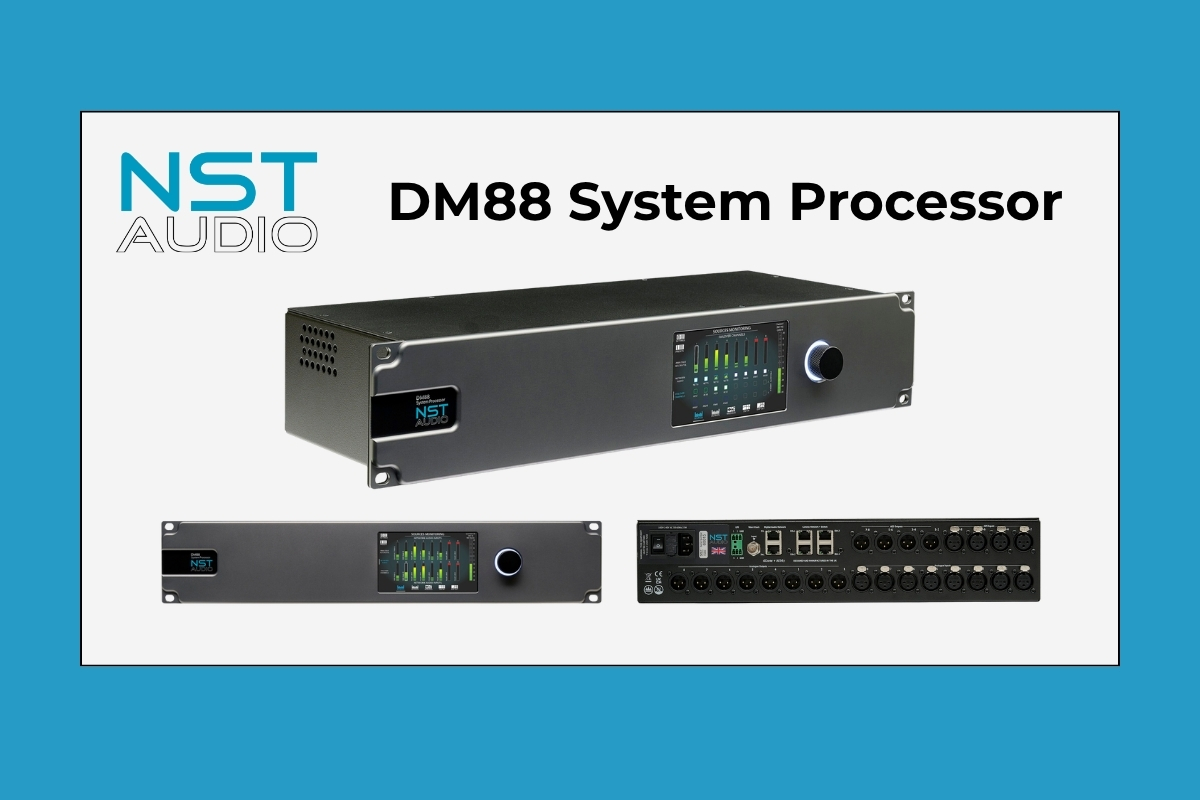
Introducing the DM88 System Processor – The Engineer’s Toolbox
What Applications the DM88 is For…
The DM88 expands the capabilities of NST processors with new levels of flexibility and connectivity meaning its a perfect fit in even more applications.
We originally were marketing it on the connectivity flexibility with the “Everything, Everywhere, All at Once” tagline, but we soon discovered that it was being used in such a wide range of scenarios that we were able to build a picture of real world use which changed the slant to the “Engineer’s Toolbox” as it’s been included in live and install cases for use as, amongst others…
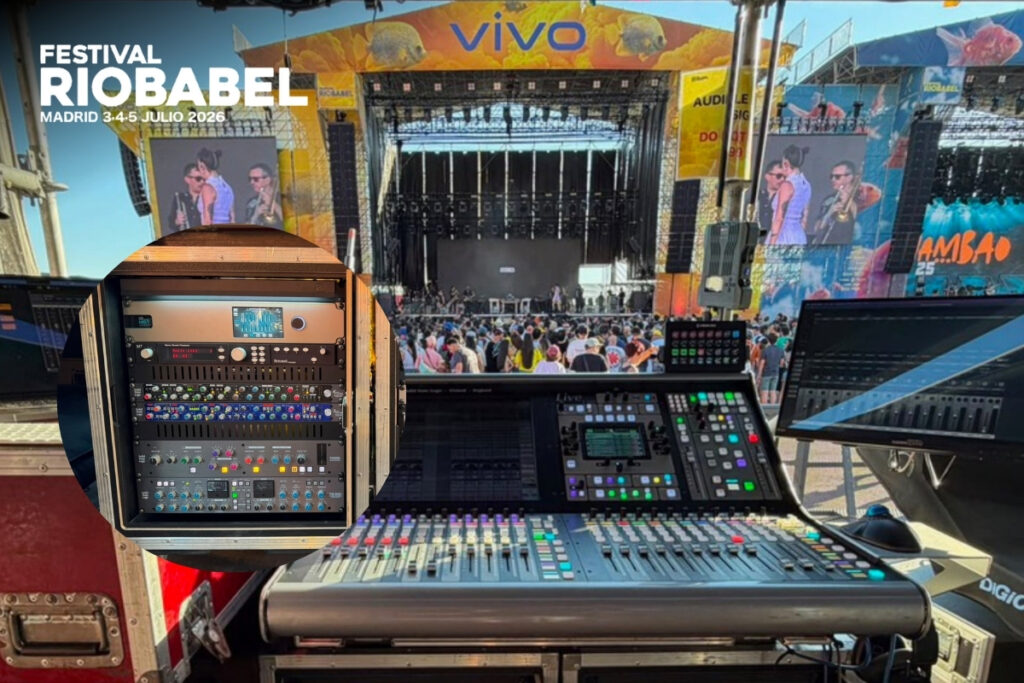
A Main System EQ
Ahead of the desk, and in both live and install cases, the DM88 has become the system EQ given to visiting engineers tat ensures the speaker management (more on that later) can be separated and kept safe from tampering(!). For example, in the 02 Academy in Leeds, the DM88 handled both system management (speaker processing) and access was given to the input EQ across linked pairs of channels for visiting engineers to “tune” according to their preferences. This “tuning” could then be removed (a highly granular preset system allows individual channels’ EQ to be recalled) with a simple reset each day (which can be triggered automatically via a VR2).
The full case study about this is here:
Case Study: O2 Academy, Leeds UK – NST Audio
Loudspeaker Management
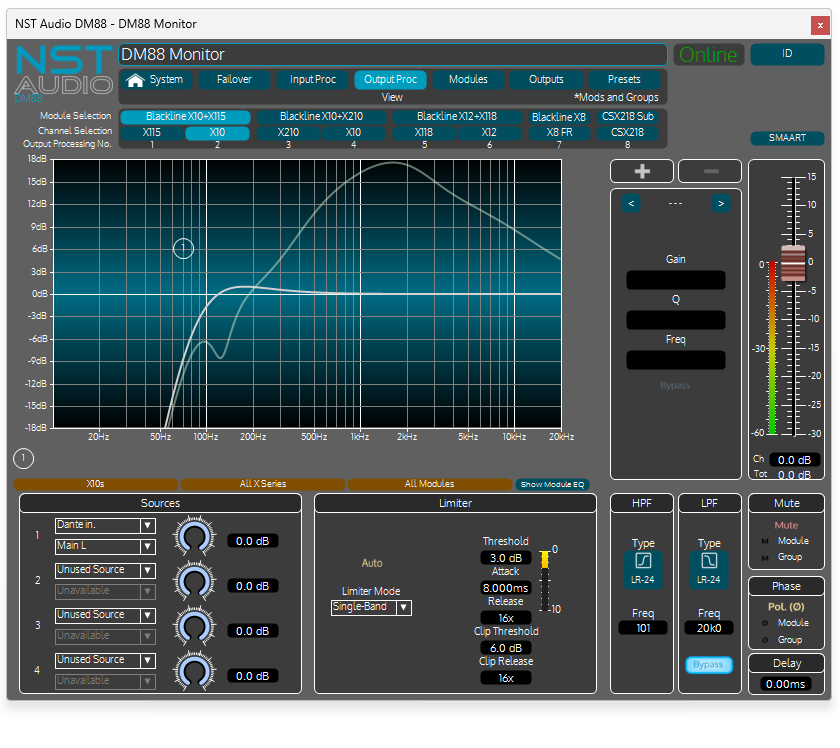
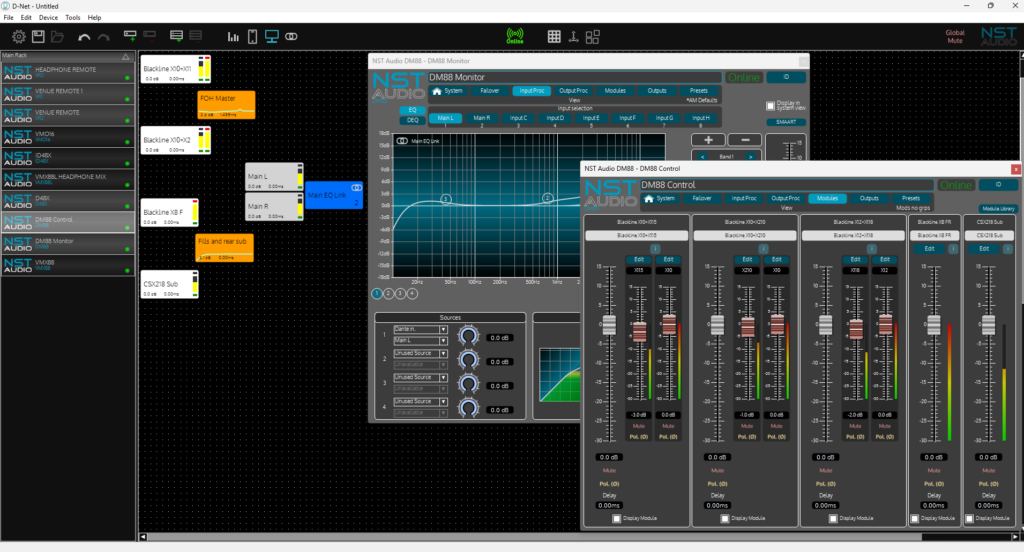
As with our other processors, a core feature is loudspeaker management – so crossovers, alignment delays, protective limiters, FIR processing. With 8 DSP channels that feature a dedicated feature set for this purpose, the DM88 can easily perform this role. To facilitate this further, the DM88 includes two new workflow additions – grouping and modules. Modules allow users to quickly pick (or create themselves!) a speaker box (or system) from a library and apply it to a set of outputs, instantly configuring them with the required processing for that cabinet. D-Net makes this process simple, and the introduction of modules (instead of presets) is also backwards compatible with all other processors (they have access to the library too). Modules are also filtered according to the older processors capabilities – worth knowing. Modules loaded into DM88s also introduce the grouping abilities of the processor.
Modules (thinking of them as speaker cabs) can be grouped in D-Net and additional layers of EQ, delay and gain added to them, allowing engineers to create incredibly system-specific tuning, depending on loudspeaker deployment, above and beyond what the manufacturer has specified for the box tuning. This could be as basic as an overall gain control for the main system and one for delays/fills in a live situation, or as complex as removal or delay shading in large arrays.
Format Conversion
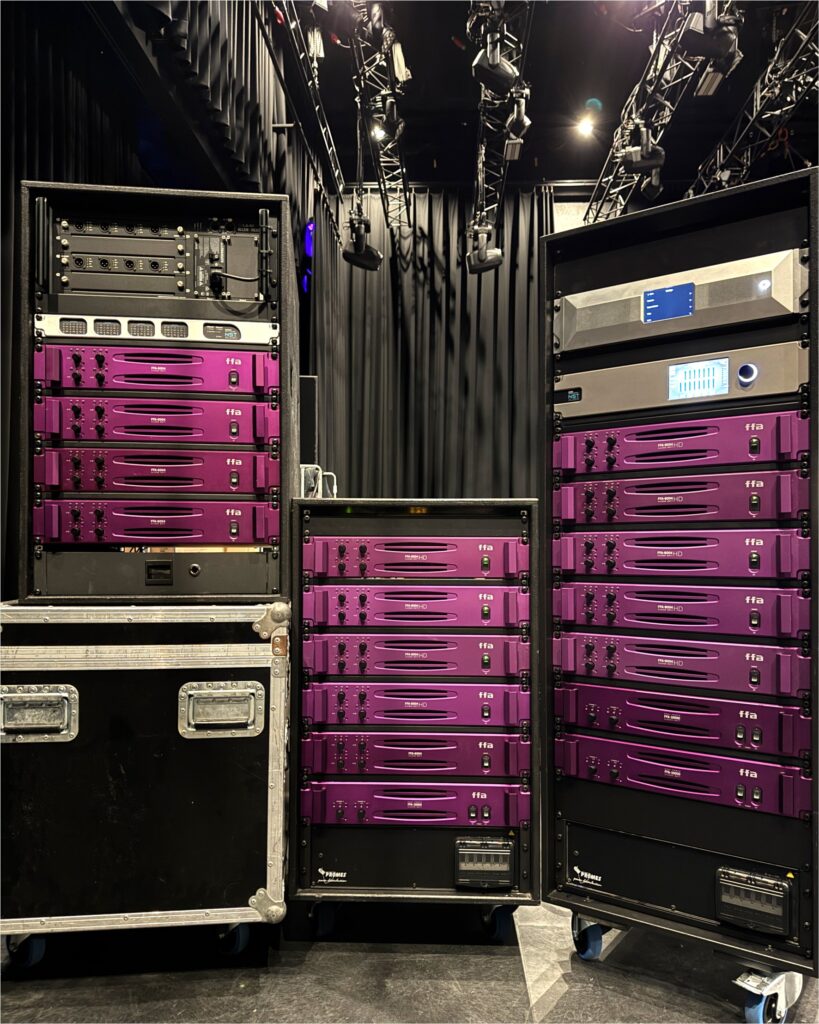
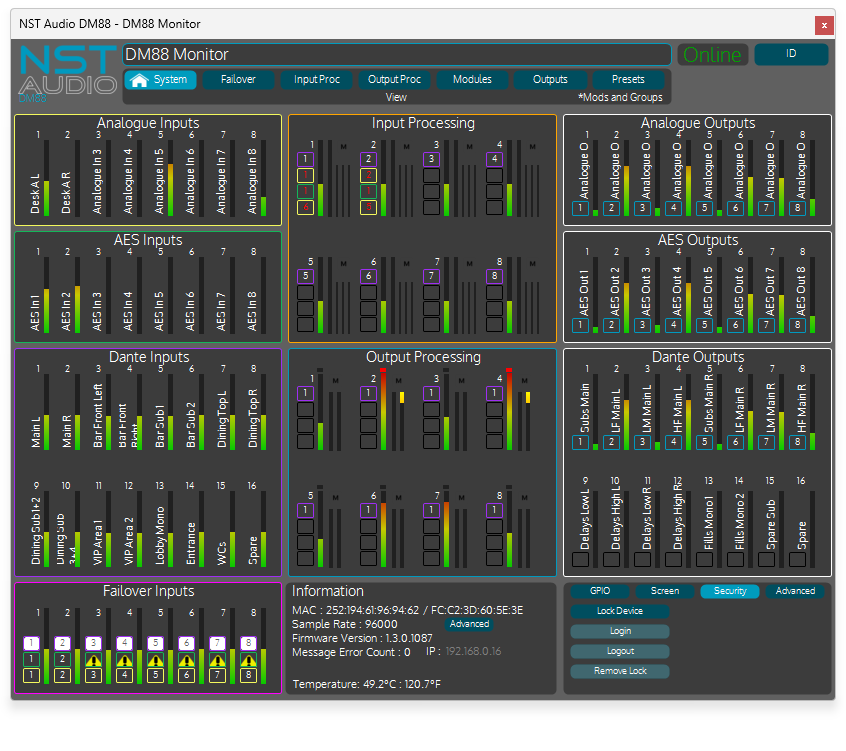
With all 32 inputs and outputs live all the time (8 analogue, 8 AES, 16 Dante), it’s entirely possible to route signals from in to out without going through unnecessary processing just to get, perhaps, some analogue inputs onto the Dante network, or create some AES backups of other outputs. Include the failover system in this mix, and the DM88 can not only function as the highest performance IO, but also as a means of swapping between audio formats. At the Neushoorn music venue and rehearsal rooms in the Netherlands, it was preforming this role (as well as system EQ!) ahead of an immersive sound processor for the multi-channel install.
More on that here:
Immersive Sound Upgrade for Neushoorn – NST Audio
Console Switching
Due to combination of input flexibility, routing capabilities and the memory granularity (that’s three different words with “ity” at the end – AI would not write that!), it’s simple to use the DM88 for switching between desks. This was part of its remit in Leeds (see above). It was also configured with some specific presets that just swapped the inputs routing that fed the system (which can also be used in conjunction with the failover system). A couple of basic presets were created and assigned to a specific VR2 for swapping between desks with no-one needing access to software or the DM88 itself. Simple, safe and quick.
Matrix and Routing
Whilst we’ve explained how flexible and powerful the routing aspects of the processor can be, the matrix mixing capabilities should not be overlooked. The matrix implementation is a departure from previous products as it’s not limited by fixed architecture DSP paths in the same way…in here > through some EQ > matrix > out here.
Now you can choose to mix up to four inputs on a mini-matrix on every input processing channel, and every output processing channel. This approach allows the input DSP channels (system EQ, DEQ compressor) and output DSP channels (speaker EQ, FIR, limiters etc.) to operate entirely independently. For example, a stereo 4 way system would only really need to use 2 channels of input processing, allowing the other 6 to maybe process analogue sources that were just fed back on the the Dante network. That preset granularity comes into its own again here – you can create a preset that might only change the source and mix matrix level of an individual channel, thereby making all inputs fully accessible to every input and output processing block.
The recently completed instal at the Trafalgar in London made good use of the routing and matrixing capabilities in a mainly active system. More on that here:
Hi-Fi Performance at the Trafalgar – NST Audio
Integrations With FFA Products
Whilst FFA have their own version of D-Net – all their DSP enabled amps, plus the current F-IF48X, and the new Tour 1 amp (with DM88 level DSP) , all appear in standard D-Net and, looking forward to the Tour1, will integrate seamlessly via iPad, mac and PC, along with all remotes and including V-Remote for iPhone.
What does this mean for engineers?
A single application that supports current and future FFA products, and opens up the possibilities of system wide EQ, speaker grouping and tuning (when Tour1 is available or before that using DM88s). It’s worth noting that the DM88 is used as the design tool for creating engineer’s own bespoke speaker or system modules (up to 6-way!) which can then be used with FFA DSP amps (not just Tour1). You can do this without owning a DM88 – just add one offline and start making modules.
As the module creation workflow recently received a shot in the arm in D-Net 3.4, we created a newer version of the module creation process which is on the YT channel here:
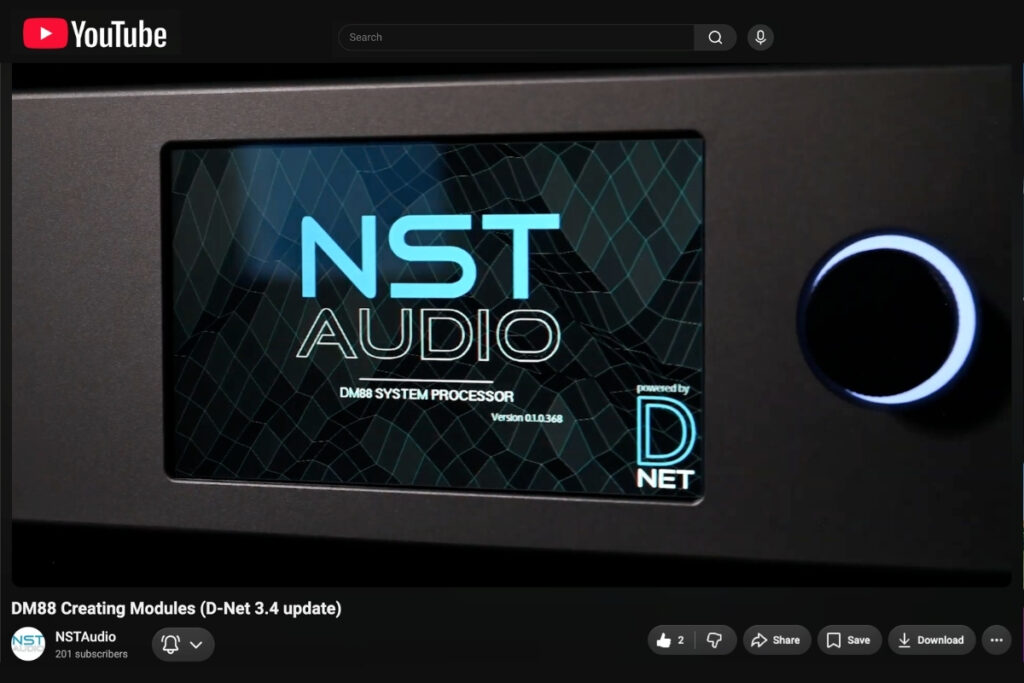
DM88 Creating Modules (D-Net 3.4 update)
It’s also worth noting the new multiverse capabilities of D-Net which can now be used simultaneously on all three platforms (and iPhone). This allows engineers to set up the main system on a large screen device (PC/Mac) and then roam about to tune via an iPad, safe in the knowledge that all updates applied on any instance of D-Net or Fatware will be syncing in real time. This was introduced in 3.3 earlier in the year for InfoComm.
Written by Waring Hayes, Technical Brand Manager at NST Audio
We hope you find this blog post helpful. If you have any questions, please do not hesitate to contact us.
Thank you for using NST Audio’s DM88 System Processor!